DNA storage for archives that still change.
Most DNA storage is written once and read whole. Verrascript is developing a molecular file system and microfluidic addressing layer so an archival DNA pool can be indexed, appended to, and read one file at a time—without re-synthesizing the entire archive.
The word "verrascript", written as DNA bases with the standard two-bit mapping (A=00, C=01, G=10, T=11). Eleven characters, 44 base pairs.
What We Work On
Three pieces of the same foundational problem: how to write less DNA, how to retrieve one file without sequencing the entire pool, and how to update stored archives after the fact. Each research track states where it stands in the laboratory today.
Molecular File System (MolFS)
A session-based delta index that records directory hierarchies, block allocation tables, and version pointers inside the DNA pool itself. Adding or editing a file means synthesizing only the differential session, not the whole archive.
Microfluidic Addressing Device
A chamber-based microfluidic architecture that isolates the exact partition of an oligonucleotide pool required by a query, preventing the need to process every strand in the library.
Editing Without New Synthesis
Writing and modifying data through CRISPR base editing of pre-synthesized DNA tape rather than chemical de novo synthesis, significantly reducing reagent cost and chemical waste.
End-to-End Appliance Integration
A packaged write, store, and read system. We do not make commercial hardware claims ahead of the underlying chemistry and unit economics.
From Bits to Bases, and Back
Test a bidirectional two-way codec. Type text on the left to synthesize simulated DNA nucleotides; paste a nucleotide sequence on the right to decode it back into readable text. Everything runs strictly in your browser.
🧬 Write: Text to DNA
- Characters typed0
- Bytes encoded0 B
- Bases produced0 bp
- GC content0%
- Longest homopolymer run0 bp
🔬 Read: DNA to Text
- Valid bases read0 bp
- Bytes recovered0 B
- Characters out0
- GC content0%
What this demo leaves out is the physical noise inherent to chemical synthesis and biological sequencing. A production molecular codec incorporates: (1) Addressing primers so specific files can be amplified selectively via PCR, (2) Reed-Solomon or LDPC error correction to survive strand dropout, indels, and nanopore read errors, and (3) Constraint-aware mapping to maintain 45–55% GC content and prevent homopolymer runs of identical bases (≥4 bp), which trigger high synthesis error rates.
Market Forecasts and the Cost Constraint
Published industry forecasts for DNA data storage diverge by nearly two orders of magnitude. Below is the spread across three independent market research firms, followed by the economic constraint that dictates real commercialization timelines.
Independent Market Forecasts (Base Year to Forecast Horizon)
Hollow circle is base year; filled circle is projected horizon. Citations: MarketsandMarkets (Nov 2023, 87.7% CAGR); IMARC Group (77.3% CAGR); Coherent Market Insights (27.8% CAGR). Verrascript did not author these studies and does not endorse any individual forecast.
The True Timeline Bottleneck: Cost per Gigabyte
Figures reported from an IARPA status update at SC22 and National Academies consultation: Archival Data Storage Technologies for the Intelligence Community. The same briefing noted the largest published DNA archive at the time was 200 MB, requiring nine independent synthesis runs.
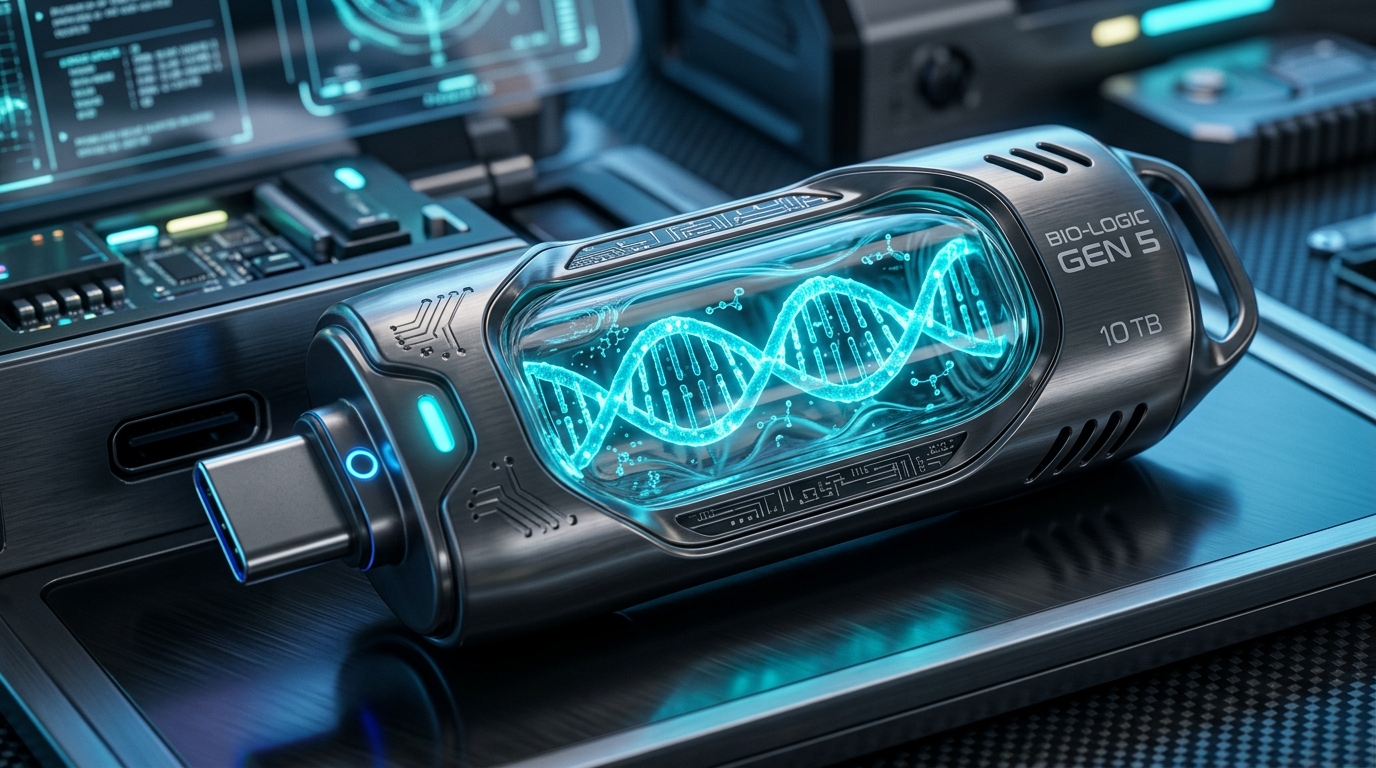
Bio-Flash Drive™ Microfluidic Architecture
Exploring chamber-based microfluidic addressing to partition oligonucleotide pools, bridging fluidic storage arrays with standard electronic host interfaces.
Physical Chamber Partitioning
Standard DNA storage stores millions of oligonucleotides in a single homogeneous droplet, requiring deep shotgun sequencing of the whole volume to read back a single document.
The Bio-Flash Drive™ architecture investigates micro-scale isolated reaction chambers. By selectively actuating microfluidic valves, the host controller can target and isolate only the specific chambers containing the requested file blocks.
Nucleic acid storage requires zero electricity to maintain data stability over decades.
Currently an early-stage microfluidic test fixture on the laboratory bench.
Molecular File System (MolFS)
A session-based, write-append molecular operating layer. MolFS enables file-level indexing, differential modifications, and random access within synthetic DNA archives.
Session-Based Delta Indexing
Rather than synthesizing the full archive for every modification, MolFS records directory trees and session deltas. Modifying a 2 MB file inside a 50 TB archive requires synthesizing only the new file chunks and an updated session table.
Virtual Sector Addressing
Emulates standard block-storage sectors over variable-length oligonucleotide pools. Integrates hierarchical forward error correction (FEC) and primer addresses for targeted PCR retrieval.
Nanopore Direct Recovery
Format designed for compatibility with real-time single-molecule sequencing. 13.8 kB of multi-session archive data was successfully written, indexed, and decoded using Oxford Nanopore sequencers.
Molecular File System Block & Session Layer Architecture
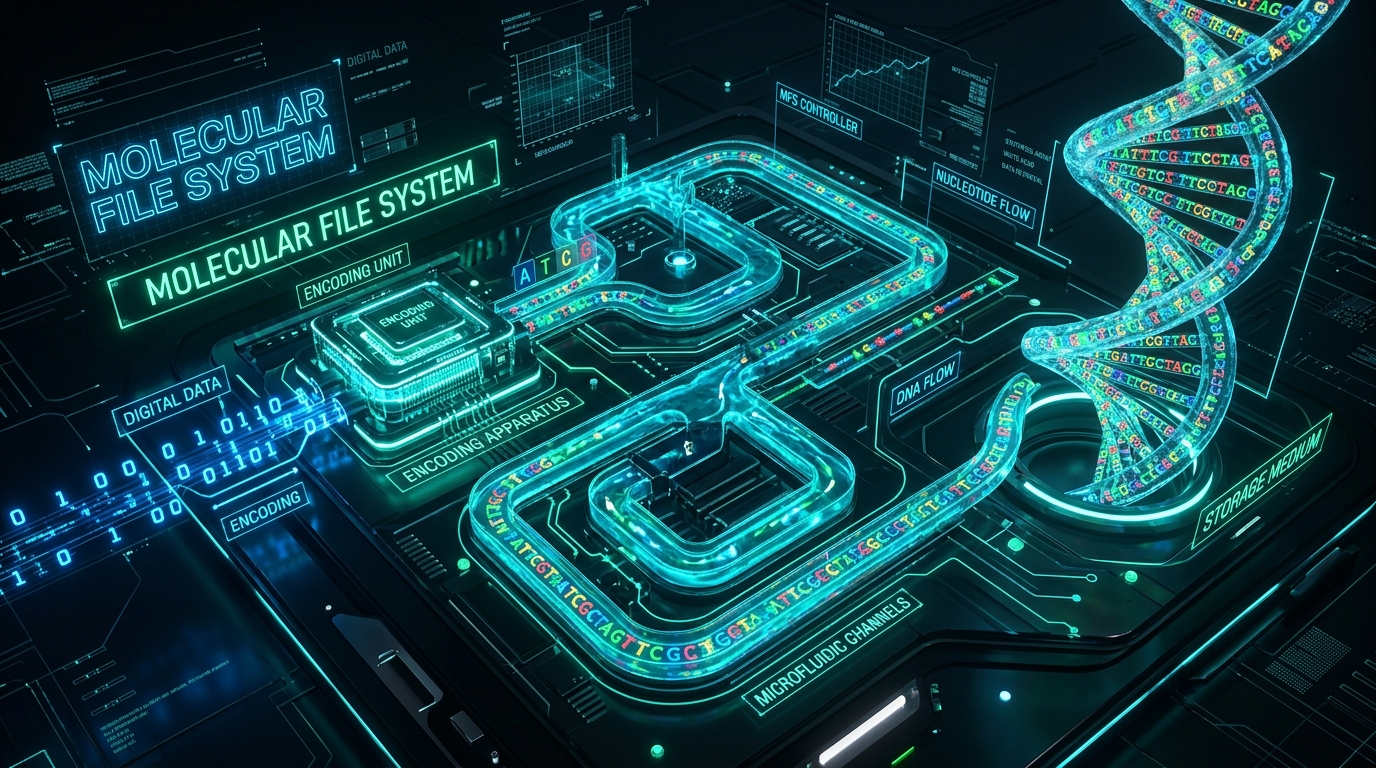
Schematic of session-based index tables, block allocation records, and differential synthesis pipelines.
AI for Biotechnology & Regenerative Medicine
A second research line, earlier than the storage work and pursued with the same foundational tools: nucleic acid design, microfluidics, and sequencing readouts. It represents computational model building on laboratory datasets, not a clinical therapy program.
Sequence & Construct Design
Learned generative models to propose nucleic acid constructs that satisfy multiple thermodynamic constraints simultaneously: probe orthogonality, secondary structure, and synthesis feasibility.
MicroRNA Biomarker Detection
Isothermal amplification readouts for microRNA targets, leveraging statistical classifiers to separate genuine target signals from background amplification across dense probe arrays.
Cell State Modelling
Analysis of single-cell transcriptomic datasets to describe transition trajectories involved in cellular reprogramming, assisting researchers in prioritizing candidates for benchtop assay.
Model-in-the-Loop Screening
Microfluidic screening pipelines where iterative rounds of experiments are prioritized by active-learning models trained on earlier cycles, reducing physical runs per conclusion.
Computational Cellular Reprogramming Simulation (Demonstration Model)
Adjust biological parameters to observe simulated cell-state attractor shifts within an in silico Waddington landscape model.
Archival Lifecycle & Energy Comparison
Explore estimated long-horizon storage footprints: compare cold-storage electricity and media refresh cycles against synthetic DNA retention models.
Estimated Lifecycle Footprint
- Legacy Tape Refreshes Avoided:4 Refresh Cycles
- Active Cooling Kilowatt-Hours Saved:2.8M kWh
- Floor Space Reduction:99.8%
- Est. Upkeep Cost Reduction:87.2%
Research, Publications & Intellectual Property
The foundational scientific record behind our molecular computing lines, cited in full for independent verification.
Peer-Reviewed Publications
Digital data storage on DNA tape using CRISPR base editors.
Sadremomtaz A, Glass RF, Guerrero JE, LaJeunesse DR, Josephs EA, Zadegan R.
Nature Communications 14, 2023.
A molecular file system for DNA data storage.
Guerrero JE, Sadremomtaz A, Zadegan R.
Manuscript in review, 2026. Conference report archived on the NSF Public Access Repository.
Nucleic acid memory.
Zhirnov V, Zadegan RM, Sandhu GS, Church GM, Hughes WL.
Nature Materials 15, 2016.
Funding, Patents & Community Standards
Academic Research & NSF Grants
Underlying academic research was performed across university laboratories, including foundational investigations supported by National Science Foundation award MCB 2027738. Those federal awards were made to universities, not to Verrascript, and no university endorsement of this company is implied.
Patent Portfolio Status
Patent applications covering the Molecular File System architecture (US App 19/189,507) and Nucleic Acid Memory concepts (US App 17/443,312) are pending examination. Verrascript claims no issued patents. Inventions originating in university laboratories are owned by the respective institutions unless a commercial license agreement is formally executed.
DNA Data Storage Alliance Standards
We reference published technical specifications from the DNA Data Storage Alliance regarding containment stability, file metadata structures, and read/write interoperability as benchmarks for our experiments. We are not currently a member organization.
Scientific Advisory Board
Verrascript is guided by leading university researchers and pioneer inventors in nucleic acid nanotechnology, molecular memory, and microfluidics.
Inquiries & Contact Desk
Direct email reaches us fastest. We welcome discussions with archival institutions, sequencing/synthesis technology providers, university technology transfer offices, and research collaborators.
Corporate Office
4030 Wake Forest Road, Suite 349
Raleigh, North Carolina 27609
Direct Communication
We do not collect personal data through web tracking forms or sales funnels. Any correspondence sent to our team is reviewed directly by Verrascript personnel.
Media & Academic Requests: Please send inquiries to our email address and note any upcoming deadlines or conference schedules.
Open Email to info@verrascript.com